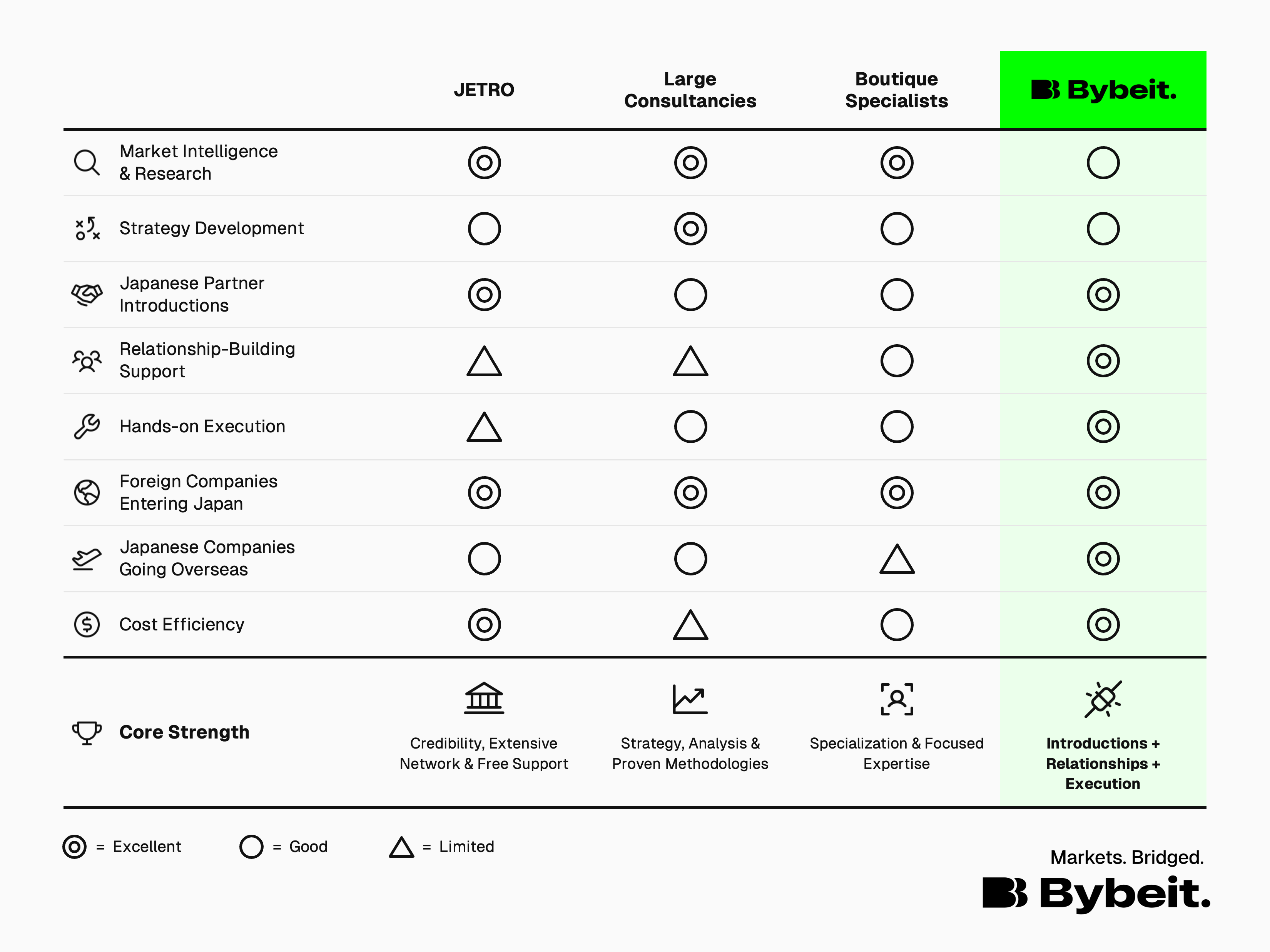
Every foreign company that decides Japan is worth entering eventually hits the same question: who actually helps you do it? The market for "Japan market entry support" is larger and more fragmented than most first-time entrants expect — spanning a free government agency, elite strategy consultancies, and a long tail of boutique firms. Each solves a different piece of the puzzle. Few solve all of them. Here's an honest look at the landscape, and where Bybyte sits within it.
Category 1: JETRO — Broad, Free, and Foundational (But Not Hands-On)
JETRO is an independent administrative institution under Japan's Ministry of Economy, Trade and Industry, and one of its central roles is supporting overseas companies as they enter and expand in the Japanese market. At its Investment Japan and Business Support Centers in six major cities, experienced bilingual staff and market experts provide consultation services, largely free of charge, to foreign and foreign-affiliated companies. It even offers free temporary office space for up to 50 business days while a company sets up its own permanent presence.
This makes JETRO the natural first stop for almost any company considering Japan — and it should be. But its structure has real limits for a company that wants an actual go-to-market partner rather than a research desk. Much of its most useful support requires a company to contact JETRO first and meet specific conditions before receiving customized information, and the core value it delivers is information, facility access, and introductions to government bodies, local governments, experts, and universities — not campaign execution, ongoing account management, or the kind of sustained, personal relationship-building that turns an introduction into a signed partnership. JETRO opens doors. It generally doesn't walk you through them.
Category 2: Large Strategy Consultancies — Credibility and Frameworks at a Price
At the other end sit established consulting firms built around structured, repeatable methodology. Firms like SK&Co. are staffed by professionals from Boston Consulting Group, Strategy&, and P&G, focused specifically on Japan market-entry strategy. Tanabe Consulting runs specialized teams across food, manufacturing, construction, and logistics, drawing on a nationwide network to solve industry-specific management issues. Fenetre Partners, founded in 2008 with 32 staff, has run international projects for over 500 companies across markets including the US, Germany, UK, Australia, and Singapore.
These firms bring genuine credibility and deep sector frameworks — valuable for a large enterprise validating a multi-year Japan strategy. The trade-off is what you'd expect from any premium strategy consultancy: higher fees, engagement models built around research reports and strategic recommendations rather than hands-on execution, and timelines suited to enterprise decision cycles rather than a company that needs to move quickly on a single product launch or partnership. You typically get a plan. Turning that plan into relationships on the ground is often a separate, additional engagement.
Category 3: Boutique and Functional Specialists — Deep, but Narrow
A third tier fills specific functional gaps. Beacon Associates is a Tokyo-based research and consulting firm focused specifically on market research, serving as a channel partner for programs like GDIN's PMF initiative. TMJ Global brings over 30 years of experience bridging international businesses with the Japanese market, with a comprehensive, end-to-end support model. JMC focuses heavily on the operational side — partner selection, hiring, payroll, banking, and accounting once a company has decided how it wants to enter.
These firms are often excellent at what they specialize in. The limitation is scope: a research firm delivers research; a BPO-oriented firm handles back-office operations; few combine market intelligence, warm relationship-building, and an incentive to actually make the match work — because their revenue model is typically tied to the engagement itself, not to the long-term success of the relationships they broker.
The Gap in the Middle
Line these categories up and a pattern emerges: JETRO is free but requires you to do most of the relationship-building yourself once the introduction is made; large consultancies are thorough but expensive and deliverable-focused; boutique specialists are efficient within a narrow lane but rarely own the full journey from first contact to working partnership. What's genuinely scarce is a partner that combines institutional credibility, hands-on personal involvement, and a direct stake in whether the relationship actually works — not just whether the report gets delivered.
Where Bybeit Is Different
Bybeit Corporation was built specifically to sit in that gap. Two things separate our model from the categories above:
We work through JETRO's own network rather than around it. Because Bybeit's connections with overseas companies are built through JETRO-supported channels, clients get the credibility and reach of Japan's national trade infrastructure — without being left to independently navigate that infrastructure's own bureaucratic front door. We act as the hands-on layer that JETRO's model isn't designed to provide, so a company gets both the institutional legitimacy of the JETRO relationship and a dedicated partner actually driving the introduction to a working outcome.
We work in both directions, not one. Most firms in this landscape are built exclusively around inbound support — helping foreign companies enter Japan. Bybeit also supports Japanese companies building connections abroad. That bidirectional model isn't just a broader service line; it changes the underlying incentive. A firm that only profits from inbound engagements is optimized to close a deal. A firm that also builds outbound relationships for Japanese partners has a direct stake in making sure the match is genuinely good on both sides — because our credibility with our Japanese network depends on the introductions we make actually working out, not just getting made.
Why That Makes Us More Efficient, Not Just Different
Efficiency in market entry isn't about speed alone — it's about how many steps a company has to take before an introduction becomes revenue. JETRO gets you a contact list. A large consultancy gets you a strategy document. Bybeit's model is built to compress the distance between "we want to enter Japan" and "we have a working relationship with the right Japanese partner," because the JETRO-backed network removes the cold-start research phase, and the dual-direction relationship model means the partners we introduce you to are ones we already have genuine, reciprocal reasons to maintain trust with — not one-off contacts pulled from a database for a single transaction.
If your product is ready for Japan, the question isn't whether you need support — every case study in market-entry research says you do. It's whether that support ends at a report, or actually gets you to a partner you can work with. That's the difference Bybeit is built to make.