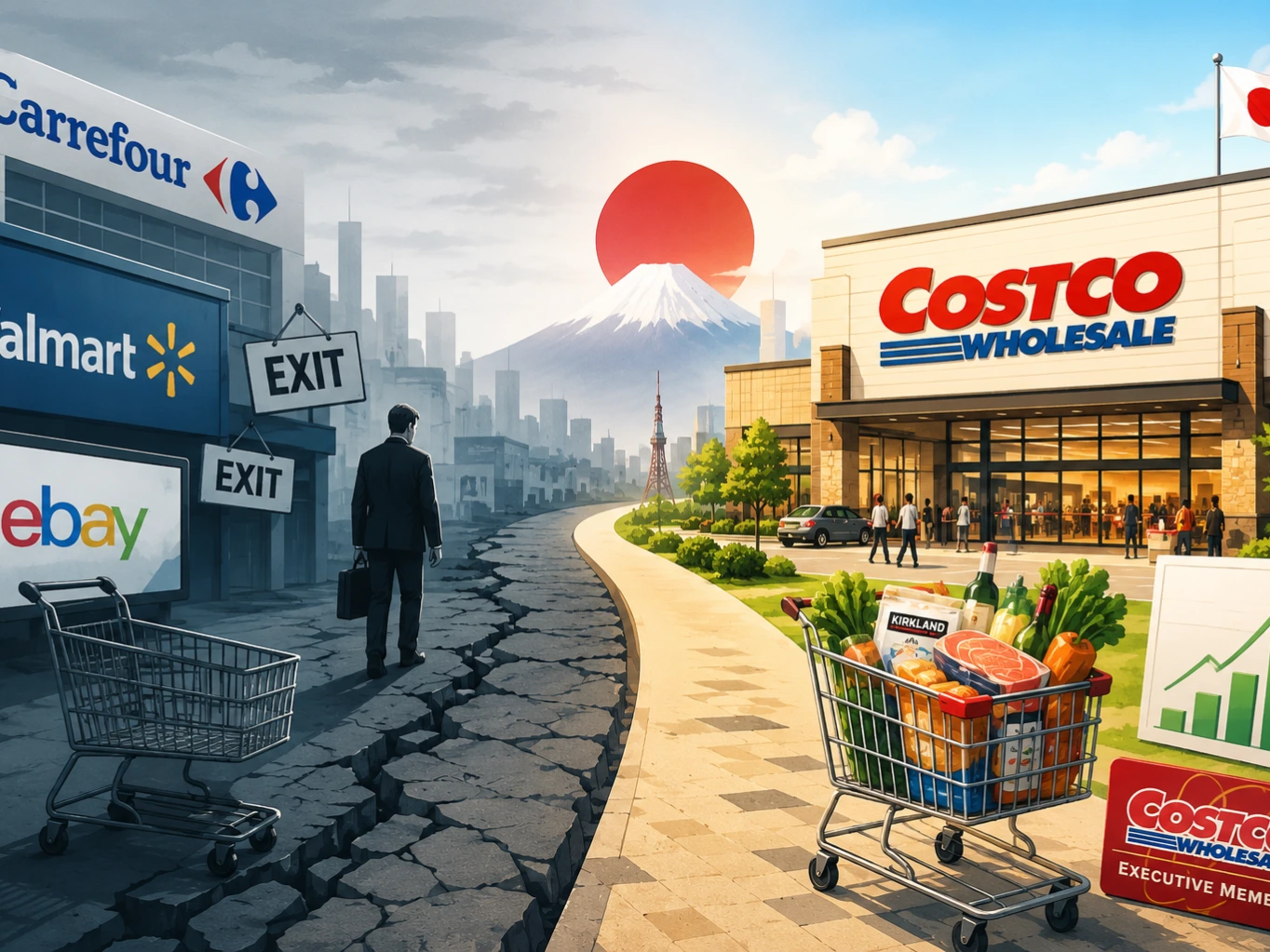
Japan has quietly become one of the most instructive graveyards — and proving grounds — for global retail. Nearly every major Western retail and e-commerce giant has tried to crack it. Some, like Costco, turned it into one of their largest markets outside their home country. Others, like Carrefour, Walmart, and eBay, spent years and billions of dollars before quietly exiting. The difference between the two groups isn't capital, brand strength, or ambition — all four companies had plenty of each. It's what they did, or didn't do, with the specifics of how Japanese consumers actually shop.
Failure Case 1: Carrefour — Scale Without Fit
Carrefour, the world's second-largest retailer at the time, entered Japan in 2000 with its signature hypermarket format: enormous stores built on the same low-price, high-volume logic that had worked across Europe, Latin America, and Taiwan. By March 2005, it announced its withdrawal, selling its Japanese operations to Aeon after five years of losses.
The core issue was fit, not effort. Japanese consumers prized freshness and shopped near their homes; Carrefour, by contrast, needed enormous plots of land for its hypermarket format, which pushed its stores into the suburbs rather than near train stations or residential neighborhoods — exactly the opposite of where Japanese daily shoppers actually went. Unlike its rivals Walmart and Tesco, Carrefour also entered without a Japanese partner, which left it struggling to secure the large real-estate footprints its model depended on and to ever reach the store count it had targeted. Its low prices attracted curiosity initially, but curiosity isn't loyalty, and Carrefour never gave Japanese shoppers a reason beyond price to change their habits.
Failure Case 2: Walmart/Seiyu — Two Decades, No Breakthrough
Walmart's Japan story is longer and more expensive than Carrefour's, but it ends in the same place. Walmart took a minority stake in supermarket chain Seiyu in 2002 and control in 2008, aiming to import its everyday-low-price playbook into one of the world's largest economies. By 2020, after 18 years, Walmart sold the majority of its stake to KKR and Rakuten; by 2025, it exited entirely.
What makes this case particularly instructive is that Walmart's own leadership admitted the entry was under-prepared: the company moved into Japan without an overall strategy or the in-store tactics needed to build real presence in a market already dominated by entrenched domestic players like Aeon and Seven & I. Two decades of operational tweaks couldn't compensate for a strategy gap at the outset — and consumer apathy toward the format never really went away, even as the ownership structure changed twice.
Failure Case 3: eBay — First to Japan, First to Leave
eBay's Japan story is a useful reminder that e-commerce failure follows the same logic as physical retail failure. eBay entered Japan in 2000, but Yahoo! had already launched Yahoo! Auctions there in 1999 — free to use, versus eBay's transaction commissions — and had built a five-month head start along with deep trust among Japanese users. By March 2002, eBay withdrew, later re-entering only through a joint venture with the company that had beaten it, rather than as a standalone platform.
eBay's own CEO at the time described the company as being in "catch-up mode" — and in a trust-driven, network-effect-heavy category like online auctions, catch-up mode in Japan usually means the game is already over. Being first to launch globally meant nothing against being first to localize and build local trust.
Success Case: Costco — Same Model, Adapted Details
Costco entered Japan in 1999 with essentially the same warehouse-club model that built its US business: bulk goods, a paid membership, and a limited SKU count. On paper, this looks like exactly the kind of "we do things our way everywhere" approach that sank Carrefour and Walmart. In practice, Costco succeeded by treating the model as a foundation to adapt, not a template to impose.
Costco reshaped its real estate, merchandising, and warehouse design specifically to work within Japan's tighter real-estate constraints and stricter retail regulations, while still preserving enough imported goods to give the shopping trip a distinctly international feel that Japanese members valued. Crucially, Costco leaned into rather than fought Japanese consumer priorities — building out fresh food assortments because Japanese shoppers strongly preferred fresh over packaged or frozen goods, something the company's own product mix data confirmed as a market-specific adjustment. Japan is now Costco's second-largest market outside North America, with 37 warehouses as of 2026, up from 20 just a few years prior — proof that scale and localization aren't in tension when they're pursued together.
The Pattern Underneath All Four Cases
Line these cases up and the lesson isn't "Japan is hard" — every market is hard for someone. It's that the failures share one root cause and the success shares its inverse:
The failures brought a global model and asked Japanese consumers to adapt to it. Carrefour asked shoppers to drive to suburban hypermarkets. Walmart asked them to prioritize everyday low prices over the trusted local chains they already used. eBay asked them to pay commissions on a platform with no existing user trust, against a free incumbent that had gotten there first.
The success brought a global model and adapted it to Japanese consumers. Costco kept its core mechanics — membership, bulk, value — but changed the real estate, the product mix, and the format details until they fit how people in Japan actually shop.
Neither the successes nor the failures were under-resourced. Walmart spent two decades and billions of dollars failing in Japan. The difference was never budget. It was whether the company treated local retail behavior as a design constraint to build around, or an obstacle to route through with enough capital.
What This Means for a Company Sizing Up Japan's EC/Retail Market Today
The specific failure points above — wrong-fit real estate, underestimating an entrenched local incumbent, arriving without a local partner who could flag these issues before launch — are exactly the kind of decisions that are cheap to get right before entry and extremely expensive to unwind after it, as Walmart's two-decade retreat shows. A local partner's job in this context isn't paperwork; it's telling a market entrant, before the lease is signed or the platform is built, that the store format won't fit near a station, or that the incumbent already owns the trust a challenger would need years to build.
This is the exact function Bybeit exists to serve for companies evaluating Japan: not a report confirming what could go wrong, but a partner with the local network and judgment to help you design around it from the start — the same kind of correction that turned Costco's warehouse model into one of its most successful international markets, rather than another name on Japan's long list of well-funded retail exits.